The One Thing AI Can't Change | Levy Cheng of FateTell
Guest: Levy Cheng — Founder, FateTell · Hosts: Tongtong & Clara
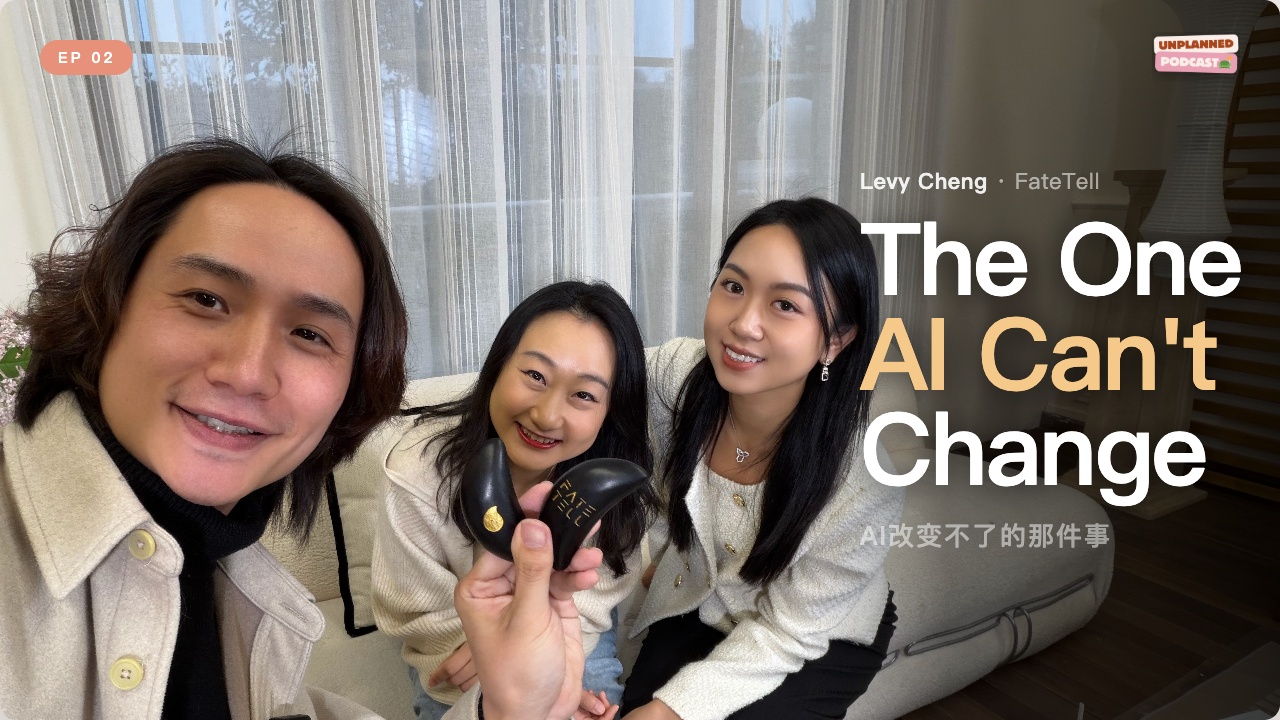
In an era when every AI founder is sprinting and pivoting, Levy Cheng sits unusually still. That stillness, it turns out, is the whole product. Levy is the founder of FateTell — an AI app combining large language models with Chinese fate-reading (命理), targeting overseas markets. In this episode: why reasoning models finally made AI fortune-telling accurate, the "millennial need" thesis, the car-and-road metaphor for fate vs. destiny, and — live on air — a Jiaobeï divination throw.
Full Transcript
Hey everyone, welcome back to The Unplanned I'm Tongtong Hey everyone, welcome to The Unplanned I'm Clara The Unplanned is where we talk about AI products,
The stories behind them, and their future, And a place where we can discuss whatever comes up So today, what I really want to talk about is Something we've been thinking about lately:
Change versus what stays the same Because AI is accelerating everything Including products, Media, And our relationship with tools in general
But we've always felt there's something very fundamental, Something ancient that hasn't changed So today, about this topic, We've invited a really interesting guest The founder of FateTell, Levy
I think Levy is one of the most distinctive AI product founders I've met And his product actually touches on This topic of change and constancy we're discussing today
So Levy, why don't you tell everyone A bit about yourself and FateTell? Sure Hey everyone, friends of The Unplanned I'm, um, haha Levy The product I'm working on is FateTell
We're focused on combining AI with What we call ancient Eastern wisdom and tradition Into a product we're developing overseas And on Feishu, um, You can enter your information on it,
And then we'll analyze it through Our ancient method called the I Ching And other fate-reading arts To give everyone a comprehensive reading And keep you company
Including stuff like divination And ways to use Jiaobeï I think you're among all the AI founders I've met, so calm And peaceful
Because right now, at this stage Everyone feels like they're entering This final sprint mode every day Anxiety Everyone's anxious and scared Worried the product launches slowly
Worried iteration is slow Afraid they'll get beaten So why are you so calm? Is it natural for you? Or is it... Eastern fate-reading That shaped your personality?
I think there are probably two main reasons One is... I actually lived through the AI 1.0 era I saw the last wave build up And then it all came crashing down And this wave is building again
I think between the two Though the tech paradigm shifted a lot But many things Like change and non-change we mentioned Are actually core elements Compared to the last AI 1.0 startup wave
Are still quite similar The second reason is probably I've been practicing Zen meditation for ten years And I meditate regularly
And I like to read about Eastern philosophy And related topics So this has gradually shaped My mindset and...
There's definitely some psychological shaping involved I'm really curious about that Like your Zen meditation practice And these fate-reading things, these... This spiritual cultivation, right?
Mm-hmm It helps you understand your fate more clearly And become more steadfast Or is it more about getting you used to Dealing with this kind of uncertainty
That's a great question It's because we do this work, you know We've actually encountered all kinds of people Different ages, different social classes Since we work internationally Even different skin colors, different ethnicities
And I realized that's actually— Why we do this A core reason is I think I mentioned this before Is that besides the basics—food, clothing, shelter, transportation There's very little like people wanting to understand and
Explore their own fate Is something spanning thousands of years We define it as a timeless human need And fundamentally, it hasn't changed And you can see it in different civilizations, um Whether it's here in China with the Zhou Yi
Or Taoist traditions In India, there's ancient Indian astrology In Arabia, there's Arab astrology And the Mayans have the Mayan calendar So really, all civilizations— People observing the stars
Or trying to understand the patterns of this world And how these patterns affect people And their journeys So this is actually Something deep within the human heart
That's as fundamental as food, clothing, shelter, and transportation A very universal need It's just that often there's external noise That society puts on us The path we're pushed onto
Makes us forget about it But now that AI is here And many people start what they call an awakening Realize competing is pointless I can't outpace AI anyway, right?
A lot, even in our hiring Fresh graduates now Theoretically should face more job pressure But they seem more relaxed Everyone's figured it out OK, lots of things I just can't do better than AI
You know? Writing papers now Taking exams Doing assignments Actually, gradually Education itself might need rebuilding So these base needs
Get awakened in people So back to that earlier point Understanding fate Is really important, helps people become Clearer-headed and more grounded
This is actually a core reason Behind our product So let me recap Like your 10-year revenue period Earlier, from law to AI Then Feishu
And now what you're building That was more Enterprise-focused Now it's consumer So there might be A thread connecting them But actually, it was also a Really non-linear development
Do you think this 'non-linear growth' was something you Were actively pursuing Was just me exploring everywhere Or was it just meant to be Like I still hadn't found the right path
Or did you feel lost back then Or how was your exploration OK, okay, Shi Tiesheng said something really classic
And actually it's just like Steve Jobs' 'connecting the dots' thing He said you can only connect dots backwards You can't do it forward And Shi Tiesheng's actual quote was something like
When you're standing at the beginning looking toward the end You feel like there are so many branches And possibilities to explore But when you look back from the end You only see one fated path And I'm now standing at my end point
But it's probably also the next start So looking back I do see one fated path So it all really did connect To where I am now When I introduce myself to people Including in past interviews
I would say It feels like there are two lines for me One visible line One hidden line The visible line is AI I studied linguistics in my undergrad And statistics Statistics was my second major—my own choice
Because I felt I was too humanities-focused back then Anyway, I was on the science track in high school Then I got recommended admission to a humanities major But then I realized that wasn't going to work I still needed to learn some science So I went to study statistics
To learn all that math stuff And then I realized that combining these two Was really important in the AI 1.0 era That natural language processing The natural language processing side of things
So my undergraduate thesis was about Some natural language processing related stuff Then I went to grad school When I was at Liu Yan Although I was studying finance at the time But because that program also Required doing quantitative analysis So I learned Python
And learned some computer science Then I graduated It was right when we were in the AI 1.0 era After AlphaGo came out As it turns out, HKUST actually Claire's from HKUST, and HKUST is
I think the best entrepreneurial university in Hong Kong So a professor told us we should do a project And we went to do AI work And legal-related stuff So this, this AI thread Is all connected
Including when I later went to Feishu Then from Feishu, I started my own AI company Actually, this AI journey has been ongoing the whole time The other journey is what we call You could say metaphysics Or a thread about fate-reading
That's, uh, back in university I went to First I read a lot of Western philosophy books I remember Elon Musk posting on Twitter I wouldn't recommend mixing high school and college students Reading existentialist philosophy too early
It creates really, really serious Feelings of emptiness and existential crisis I was going through that back then And then I met this My senior brother He was supposed to go to Yale to do his PhD in philosophy
We talked about a lot back then Stuff about Western philosophy Then one day he told me, hey I don't think I need to get a PhD anymore All my philosophical questions have been answered I was like, wow That's amazing, how'd you solve it? He said he found this teacher
And then he did a Zen meditation practice And the experience was really great And the teacher was very modern A young teacher Not the old kind people usually imagine
And he Created a lot of structure for him And helped him understand things So I said, hey, that's great And then I also did Zen meditation It was 15 days You have to hand in your phone And do lots of practices
If you go I've been I completed it They have similar things But ours was different Our meditation retreat I still think it was really special So in the evenings,
The master would be like, Similar to ancient Athens schools, Everyone would sit together, But it's not like reciting the Diamond Sutra or anything, Heart Sutra, stuff like that,
The master would pose philosophical questions, Really like the Athenian academy, Discussing what freedom is, What ultimate responsibility means, What love is, Those kinds of topics, Though I only realized later, That actually, behind it all,
The framework was Buddhist teachings, Using that philosophical logic, But it really resonates with today, Especially for young people, So I did 15 days, Of Zen meditation, Then 15 days of volunteer work,
Basically a whole month, And after it ended, I felt like my whole mindset, Completely transformed, Before that I was super anxious, I just did one thing in college,
Didn't even date, Dn't dated for 5 years, Just building my resume, I was really clear about it, From freshman year, I wanted McKinsey, No one from our school had gotten in, And since we weren't a target school,
I thought, this is worth pursuing, So I spent all of college on my resume, Packed it full, And in the end, from Sun Yat-sen, I was probably the first to get a McKinsey interview, As an undergrad,
Went for it Sure enough, I failed Sure enough And I got depressed That's when everything else started All those kinds of things I was really competitive and stressed Very anxious, wanting to
Ving differences from people around me A different kind of personality And that created After that Made a big change And gradually It became part of my life
Like an important foundation What do you think about Western vs. Eastern philosophy? What's the um essential difference? I think the key difference is
Western philosophy doesn't provide any answers But Eastern philosophy actually does Western philosophy raises a lot of questions That sparks your thinking
Whereas Eastern philosophy gives you Call it an anchor or mental anchor It makes you feel more Grounded And it provides a method That's not even mentioning
If you shift from Eastern philosophy to what we call The so-called um Confucianism, Buddhism, Daoism True spiritual practice There are actually many methods You can practice in daily life
Western philosophy doesn't really offer anything like that Something you can actually do daily, right? Western philosophy is more like a very scientific system He teaches you ways of thinking But he doesn't
Like, how do the results turn out? He doesn't... he doesn't at that... He gives you guidance Whether it's direction or whatever Or like, something you can... Something you can do every day
I don't know if this is Western philosophy or... But now it's definitely very popular Like, manifestation Manifesting To manifest, right, manifest Manifestation is kind of metaphysics
Like, that's also gratitude You're also practicing gratitude Because to manifest yourself For the purpose Then you have so much, so much Daily actions on TikTok And from that, because every day
You're definitely doing behaviors So you'll have so much more inner... That sense of calm Emotional feedback He's saying, I've actually really researched this
I think manifesting seems like it was actually... Also born from Eastern influence Because there's this route Like, Buddhism was transmitted from India to China back then
Some came from Tibet Inherited that Indian um... Inherited Tibetan Buddhism Then um, many Tibetan um... Monks later went to Cambridge in Europe Or went to the Bay Area
At the same time, a batch went to Japan ? Then some Zen masters from Japan went to the Bay Area It influenced people like Steve Jobs Steve Jobs was basically a Japanese Zen master, right? And these hippies from back then So much from that generation
So it eventually formed over there Something called New Age A whole movement But because it actually blended East and West Including Tibetan Buddhism Chinese Buddhism and lots of All kinds of Hindu concepts
So I always feel like looking back It's still the Eastern system at the core Because you won't find it in any Western philosophy This kind of manifesting thing Because I think this is something very modern
OM is a cultural wave That emerged Yeah, exactly In those classic texts There's this AI product called Manifest
I actually downloaded it And then it just feeds you stuff every day Some mindfulness content, you know But like, this whole fate-reading thing Seems in the West Maybe people have heard of Bazi
But maybe not as many people are invested in studying it That's pretty interesting It's why we're so determined to expand overseas One really important reason is We think overseas is clearly
A much larger growth market And our whole team has this conviction We have this belief that what we call Chinese traditional culture's overseas revival
Is something that takes at least a 20-year cycle to start A really important thing Of course we're already seeing some The so-called vanguards or trendsetters Like for example, Black Myth: Wukong, right?
Because before that, everyone Thought Wukong was from Japanese anime Wukong from Dragon Ball But now everyone knows, okay Wukong is a monkey With uh, Journey to the West elements Including how they scouted Shanxi
All that ancient architecture And put it in the game And when foreigners see it, they go wow Many want to come visit Shanxi It's actually cultural Spread, including what they're planning next The next major IP
Is to make Black Myth: Zhong Kui Nobody knows Zhong Kui Many Chinese people don't know who Zhong Kui is But he's a very local Daoist Cultural vessel So all this, including Liziqi And including many of these overseas
Actually I think it's just beginning And then we We really pay attention to some Like, recently we've been looking for KOLs and KOCs And you see Some really interesting ones Like, the Hanzi Uncle
Is a foreigner A German guy, probably some kind of linguist Teaches you about the origins of Chinese characters Or some foreigners teaching Heavenly Stems and Earthly Branches Many Chinese people don't even know what those are
And there's also Bazi The Chinese zodiac And they think Bazi is Chinese astrology It's Chinese-style astrology We've actually been gradually tracking Google trends with these
This year there's been a trend with China Max As for China Max and all that Because Chinese astrology and that code... Actually had a spike back in June 2025 So it was because of that back then Maybe because of Mercury retrograde or something
And then foreigners would search for Other methodologies and such We can actually all see this trend So you think people's view is like Bazi is Chinese astrology Is that right?
I think You think it's Chinese Astrology, is it really just Chinese horoscope? And I think every time we translate When we give examples to translators They always come back different So the strategy is to promote Bazi
Like, just use the term Bazi With the pinyin for promotion I think that's also very, very A really meaningful approach Because I think the story checks out Because Bazi's Core is really astrology
Like, all these things you Consider fate-reading related Whether it's Indian Vedic Or those Mayan calendars we mentioned Are essentially about observing The universe's planetary patterns And their influence on human fate
People just don't know it For instance... Everyone talks about offending Jupiter You guys probably don't know either Do you know what Jupiter actually is? Some kind of creature A divine beast? Taisui is actually Jupiter Jupiter Taisui is actually Jupiter
Okay Because Jupiter has the largest mass So actually, among these planets The impact it has on Earth is the strongest So Taisui is Jupiter
And in Bazi, there are the sixty stems and branches The heavenly stems and earthly branches - 60 The 60-year cycle is the Jupiter-Saturn cycle There's so much that actually traces back To ancient astrology Or ancient astronomy Many of those manifestations come from there
This part is actually quite interesting We're doing a lot of research on this too I hope we can do it through A more modern approach So foreigners can better Understand the principles behind it So you... You think across different cultures, whether it's astrology
Or Bazi They're just different symbol systems for The patterns behind the universe Yeah, that's what I think They have many similarities What's behind them connects The connections Going back to
The FateTell product What scope should it have To capture the rules it can calculate These symbols That's like, his ability, right?
I think it's really great I wanted to do this back in the AI 1.0 era Back then, like... In 2017 When we were working on that AI and law thing I was constantly with my...
Because my CTO was my classmate, you know Every month it could be like... Why don't we create an AI fate-reading system And then he later teased me about it, saying This almost became our monthly office joke Everyone would bring it up with him
But the thing is, the LLM tech back then We all knew, right Was like the earlier version Like, for any given task You needed to train a separate model Including when we worked on legal stuff For English translation Like, we had this one business Doing patent translation, you know
English translation needed one model Portuguese needed another model All these different languages Each needed its own separate model Fate-reading is actually incredibly complex So there was no way we could've pulled it off back then And actually back in 2023
I made kind of a prediction I figured, with an LLM, a large language model The better its coding and math abilities The better its math and code capabilities Its fate-reading power would definitely be stronger
Turns out that's exactly how it is We basically waited until GPT's o Series and Deepseek's r series, and later Reasoning models came out That's when it really took off, you know
Like, people would actually use Deepseek r one for fortune-telling The differences actually came out way earlier So why didn't anyone do it? Because the predictions just weren't accurate It just didn't have that reasoning process So about fortune-telling Actually, it's called fate-reading
The 'li' means, um... The 'li' in reasoning The 'li' in reasoning In ancient China it was called the arts and numbers So 'arts' is the mathematical arts But there's another 'arts' in magic The first is the mathematical arts
So it's strongly reasoning-based It's logical, right? Recently there's this Korean variety show that's super popular It's called, um, Heavenly Secrets Trial or something Not sure if you guys have seen it It's like the #1 show in Asia right now
They gathered a bunch of These masters And they battled it out Of course, the masters split into two groups They basically divided into humanities and sciences Or like What I mean is magic versus the arts and numbers
Magic is like, channeling spirits So the essence behind Bazi Is what we'd call big data You could understand it that way Because I studied statistics So I've always had A statistical perspective on this
And I always thought there was this analogy I mean, if it's easy to understand Actually, Bazi and MBTI aren't that different People love being categorized So why is MBTI so popular?
It's because it provides a Way to categorize people like we said A great framework for understanding yourself But MBTI's got a 1 in 16 probability And everyone's already pretty happy, right? Lots of people will Say after taking the test, right?
They'll say wow Congrats, you're in the top percentage Clearly, there could be people just like you Actually, tens of millions of people could be exactly like you But you're still pretty happy
But Bazi is different, right? Bazi is, ah, 60 times 12 times 60 times 12 times 2 I mean, if you factor in gender That's 1 million combinations total So you're 1 in a million—truly unique That's way rarer
Though occasionally you might meet someone But I haven't run into one yet With the same Bazi as me Probably... I mean, you might meet, um, Hundreds, even thousands of people like you But the odds are still pretty slim
So basically you can Guarantee something truly unique That's way cooler than MBTI Plus MBTI requires you to answer
Over 200 questions Bazi doesn't need you to tell me your birthday, OK? And I can just give you Everything But I think what's different about Bazi is Bazi is based on the moment you're born As an anchor point
As the foundation, right But MBTI seems kind of different Because it's testing you So it can change Yeah As you experience things while growing But actually, for most people's MBTI
Doesn't change that much I actually talked to people who do MBTI training They have to get certified and all that I've chatted with those instructors Because actually, taking MBTI assessment Is quite a professional thing It's not like you just fill out a form online
If they're doing full MBTI Training, you take it three times First time you do it yourself The second time, the teacher goes through it with you carefully Explaining the differences between each dimension
What they really are And then after that You take it again Then you get two different answers If they're different The teacher then helps you Based on some of your actual real
Life situations you've encountered How you would react They calibrate it for you And finally establish your MBTI type Once it's set, basically It won't change Much Do you think maybe it's more
About subjective versus objective? Because when people take MBTI They might not give their most honest answers I guess I might be
Pretty introverted, but because I want to be more outgoing I get what you mean So there's like the ego or whatever, and The super-ego thing, you know, that relationship So that's why we need Like a coach to help
Correct it, so you need people to come back And then you go back and Find your—find your Come back, like a process Or vice versa The Bazi system, it will Because of acquired influences
Or external influences Can change That's a really good question So we actually Honestly, doing this until now I think all the questions, um, whether from investors
Journalists or whatever—the best ones they've asked me Was back at Geekpark with Teacher Zhang Peng We were at the Xiaohongshu Independent Dev Competition finals About to pitch And then he asked me a question I thought it was really well-asked And he said What you want is for people to believe in
Accepting fate, or transforming it I think that's an excellent question You have to genuinely care about people To ask a question like that My answer back then was like that too I mean, at least from what I observe
Our users and my fate-reading Partner's probably calculated tens of thousands of Bazi There's actually a journey We think there are three steps Kind of like what Zen says First, the mountain is the mountain Then, the mountain is not the mountain
Finally, the mountain is the mountain again I think users need to first accept themselves Then understand their fate, then transform it Accepting yourself means It's the 'know' in knowing yourself It's not like you're just defeated I just felt like everything is completely predetermined
That fatalistic way of thinking It's just knowing yourself And all Western philosophy is about knowing yourself ? So they need to know themselves first MBTI is one way to know yourself Bazi gives you a tool
It gives you 1-in-a-million uniqueness You know yourself Knowing means understanding and grasping After many people get their reading They get curious Like, how is it so accurate? Why does this work
It sounds so scientific They'll look into what's behind it Some even end up actually Studying astrology-related things Then they want to understand what's underneath it all So many of our users They're like, when are you doing courses?
Sell courses already—we want to buy them! Then there's the educational side It's about knowing, right? Recognizing and knowing Knowing and understanding, understanding and grasping And finally, transforming your fate People definitely want to
Live better, right? It's a fundamental human need MBTI also has a concept like that ? Like, high-level INTP Advanced ENTJ versus, say, low-level INTJ It really does have a threshold
Bazi is exactly the same Thousands of people have the same Bazi as you There's definitely bugs What we hope is that each Person can live out their full potential Their best traits within that fate So this thing about changing your fate
Is really just a Systematic endeavor I think that's right Even manifesting, in a way, is changing your fate ? We can see it like this
In ancient China, the best Book is called 'The Four Lessons of Liangfan' I don't know if you've heard of it Someone recommended it to me —this book, ten years ago when I mentioned it Basically nobody knew about it It was extremely niche
But it's a true story Like, it's um... I forget if it was Qing or Ming Dynasty, it was a family teaching So there's this guy who as a kid Got his fortune told by a fortune teller, and every detail was right
And so he just believed it completely How accurate was it? Like, one time The master told him Your annual salary is exactly this much rice Precise down to the number And for the next few years it was all correct Then one year they suddenly found it was off—it was less
And then he said Looks like the master totally got this one wrong Then a few months later He mentioned it to him I got it wrong, let me clarify But after I fixed it, it was exactly the same again And he thought that was terrifying
He felt like the world was All fate, so his heart turned to ash Then one day he went To visit a Zen master And the master said, well Let's meditate together
He sat there for three days and nights without moving Chen Yu said, wow This guy is incredible Yes, very few people can meditate for three days straight Shows his mind was extremely still But when they asked They found out he'd already given up hope
Like his life was already over With no desires at all So it was more like A state of complete numbness The master actually laughed and said I thought you were Someone very ambitious and driven
But I found you're like this So I told him Your fate can be changed You need to do good deeds And cultivate good habits Transform your consciousness
So he gave him This kind of booklet To record every day The good deeds he did The bad deeds he did How many good deeds I need to do Things like that So the fate-reader D already calculated it all for him
They said he had no kids Maybe he'd die at 57 So many things like that But everything changed He ended up having kids Didn't die at 50 either Things got better and better So afterwards
I had this viral hashtag on Xiaohongshu Continuous journaling transforms your fate Same with certain people And like, recently, right That Anco thing was viral too
On Twitter 30,000... no wait, 200 million I posted like two or three posts One called 'How to Change Your Life in One Day' And 'How to Change Your Life in One Hour'
So that literally translates to How to transform your fate in one day How to transform your fate in one hour And you'd see it's really similar to I think it's the modern 'Records of the Way' Like it tells you You need a ten-year vision
And a yearly vision You need an anti-vision If I don't transform my fate Or make changes I'll fall into that kind of State So I need good habits And through those habits, shift my consciousness
To change everything after Transform my vision Then I can do really well I think what's most important about changing your fate Is that you know for yourself you need to change Wanting to change, wanting to change I think that's it
Their will is the biggest factor The key to their success But I-I-I'm still thinking Or at least in your product How do you approach the idea of changing fate Or like, if a user says
Why isn't this year suitable This year it's not a good time to start a business But I really want to So they just went and started one So how would you advise them then Without changing fate, this is something we
I still think that in general, fate-reading itself S very high ethical standards So we actually invested a lot I'd say FateTell Lots of people asked us about FateTell versus other products
What the difference is I could list many differences But the most direct and quick answer is We have fate partners Clara's also talked to them about it You can feel what's behind us
Whether it's methodology or values, we're hoping to Align with our fate partners This actually comes from my legal AI work Just brought that methodology over I think everything about us
I still position FateTell as A vertical product A vertical niche offering Even though whether it's B2C or B2B doesn't matter But your vertical positioning definitely is key You need a good benchmark to measure against
Or, um, to create A standard for evaluation What we see now Are successful vertical products overseas Whether it's Harry or Open Evidence ? Harry has lawyer partners
And Open Evidence has doctor partners So we're basically Benchmarking everything we build The best fate-reader I could find Is our current fate-reading partner Many people have asked me
How do you judge Whether a master is truly skilled? Because I went through hundreds of people To find our current partner I think it comes down to two things One is whether their technique is genuinely strong
Do they have the real skill? The calculation part That numerology aspect —it's about the past Can they accurately calculate your Past situations? Because the logic is very clear
If you believe someone can Figure out all your past well Then you can trust them about your future So the foundation is just reasoning It's technique After they've worked through thousands of cases
They do reinforcement learning In their own mind They've built a model That's what we need to replicate And run through the system But about this idea of transforming fate you mentioned
It's really Meta—it's predicting and advising on the future This is actually quite important, It's about your product's values, Or your fate-reader's values, ? Because like, we said,
That thing in Fan Si's teachings, This thing, in a sense, Is actually done by the Zen master, Not by the fate-reader, For a fate-reader it just ends like that, Just tells you, okay, You'll die at 57,
You won't have kids, That's it—I don't care about you, What happens to you next, I'm just giving you a cold, hard conclusion, I've seen a lot of masters like that, They take pride in being accurate, Especially about the past and future,
If your future is actually predicted correctly, And you come back to them, They'll be even more pleased, saying look, I told you so, That's the mindset they're in, But our partner is different,
He really hopes his predictions won't come true, Because it means you've changed, It means you've truly, Actually turned out different from my prediction, He doesn't care,
He has no ego, He's not like—I have to be right to prove myself, Then oh, it turned out differently, Come find me, Then he'll tell you, okay, What's done is done, Up to this point now,
If I truly predicted everything correctly before, What's the logic behind that? I hope you can break free from this in the future These constraints and restrictions on you He actually often uses a really good analogy
It's this car and road analogy It's on our website and On some of our other platforms So fate-reading is kind of like talking about fate and luck We call it fate-luck
That's what FateTell is Fate is destiny Fate is the car It's what type of car you are Are you a BMW Are you a Land Rover Are you a trike Are you a truck, right
Luck is the road your car travels So some cars are definitely great, right But a BMW on that mountain road Might not be as comfortable as a tractor
So there are fit points between them So there's a crucial point here It's the driving factor Whether you're in self-driving mode
Or whether you yourself can Actively control the steering wheel Most people he's seen are in that mode That's why we can predict accurately Because if you're in self-driving mode In autonomous mode
I know what car you are I know what road you're on I know the road conditions Then I can predict it accurately So we want users to Shift from autonomous driving to active driving
What we call Take the steering wheel of your life That's a pretty vivid metaphor Then they can make some changes Because we mentioned it before Bazi can't pin down such specific details
There's a range There's a bar Like, with the same Bazi There's flexibility above and below At least from what we've tracked It's actually quite substantial We definitely hope users through good
Behaviors and habits reach that upper level I actually have a really curious question Like, to explain my background I'm a paying user And I use it often I'm on the 99 yuan paid tier
So I can keep asking the divination blocks Keep asking Then I discovered my usage My habit is, I only use it before business trips Like when I have somewhere I'm unsure about going
Because I often travel for work And encounter many interesting journeys So but I But it's a trade-off with time So I'm really I only do it in that moment I just have to open the app
So could you just help me decide Because I really don't know what's right But I think for me as a user This use case is still quite niche And I want to know about others Like, what's a typical user
In what state are they when they open it And what they need to know about their fate Got it, got it You just mentioned a pretty Typical use case But my situation is quite different
Within metaphysics, there are actually Many, many different scenarios Especially since we just mentioned That concept called the arts and numbers Actually, within the arts and numbers Or rather, in our traditional
System there are actually five major categories In Taoism It's the Five Arts: Mountain, Medicine, Fate, Physiognomy, and Divination Mountain refers to going into the mountains for cultivation Including grain-fasting, right
Didn't you two do grain-fasting recently That falls under the Mountain category Like cultivating internal alchemy Or going into the mountains This currently doesn't seem related to AI
Maybe it could be connected I'm not sure Like using AI for grain-fasting to help with some Health-related wellness adjustments And Medicine refers to TCM and Taoist medicine Wasn't there at that event A Taoist priest
Using divination blocks to read for people That Taoist priest was Providing health-related Taoist and Chinese medicine Treatments And Fate is Levy's main focus
Fate-related work And Physiognomy Is like reading palms Reading faces And reading the stars Even feng shui and geomancy
Different aspects of Physiognomy And Bo—that's divination, Divination is what FateTell does Like the Jiaobeï We also have it on our web platform
Things like the 64 Hexagrams FateTell's main focus right now is still Concentrated on two areas: Fate and Divination Fate is like the Book of Destiny The Book of Luck—heavier content Long reports Users might need hours to read through them
Including yearly luck reports Once they get them, they explore And this is relatively Not a high-frequency use case Now divination, as we just mentioned, All the different problems you face daily
Users can come ask about any of them And based on situations Relatively, Fate is more about the person And divination Is more about the situation So what's the point of divination? Divination—um, I read this quote before
And I really loved it It says the essence of I Ching divination Is when people need to make a decision To help people Reduce internal struggle
Gather energy And take action That's the process. So it ? You're reducing a lot of this I'm stuck all day on 'a or b, yes or no' That kind of thing
Through divination It gives you an image, right? And through that image Whether it's after you throw the Jiaobeï and get a divination result Or through other methods Helping you
Reduce internal friction And then take action So it's really different from that You know, the Bazi reading is quite long Like our 20,000-character fate reading They're truly two different scenarios From your observations of users
And you could also ask Tongtong about her take What do you think users feel when they're talking to FateTell What kind of role does he seem to have Is he a life mentor Or more like an AI companion
Mm-hmm Or a fate-reader We actually first, definitely... um, no We don't look at user chat records That's a strict boundary A hard line for us
So actually, all our feedback comes From direct user research Or from seeing what users write Like on the App Store Or um, Xiaohongshu Or Jike Or on Reddit In our reviews
And from past conversations I felt users See FateTell as Like, I have this typical user My former boss at Feishu, Boss Qian Who's now become one of our heavy users
Basically whenever there's Any kind of bug He's the first to report it He sent me such a long voice message Like, wow So glad you quit
You're building such an amazing product And that eased my anxiety He's the one But he doesn't use divination that much He really likes using that It's the Dà Sīmìng on our web platform On the app, it's the ask me anything
That's what we We're also planning a redesign Because it has memory It has your past context It has your Bazi So it can address specific situations Providing the event perspective
The time perspective The fate perspective, with analysis and advice His description of this feature is He thinks it's like a really Advanced coach
That gives lots of extra Input and kind of Like, he sends me screenshots When he's chatting with it For example, he has Project reviews or
Or reports to his boss or Or whether to buy a house soon or These kinds of Key decision moments He asks it And FateTell, based on his past context,
His personality, His current state, His luck situation, Gives him a really comprehensive analysis And provides him with The psychological insight he feels is right
Because this is what we hope to Align with our partners on Which is on a psychological level Support, right? Because you've also had readings with XiaoLin, and like The kind of thing he provides That emotional and psychological support
So this is what we're hoping to achieve Really, what this product does is take A massive fate-reading system And use AI to understand and generate from it
And then interact with users In this process, what do you think Like, compared to a really good fate-reading master What are the things that AI can do That it can structure really effectively
And what do you think still doesn't work well for AI now I actually lean more towards the optimistic side I think at this stage of the product
Basically everything a Mid-to-upper level fate-reading master can do AI can do too The challenge right now is Including where we want to make a breakthrough
Which is how to achieve The level of truly elite fate-reading masters, or even Because my other partner and I have been Exploring whether we can actually surpass them
Because being able to surpass them Is where the real value is It's that I, because I am Someone who lived through the AI 1.0 era AlphaGo shocked me so much back then Including that I actually rewatched it recently
That AlphaGo documentary Including that Demis's recent documentary The 'Thinking Machine' documentary It's all in there I'm firmly convinced that With sufficient data feedback
A closed-loop and self-involvement process After intensive learning Any field with relatively structured data Can give rise to intelligence that surpasses expert level
So if we can produce something that surpasses Go Because as you said, Go masters also are Very abstract, just a feeling, right? You think you need a lifetime of practice And maybe there's this one divine move
And it's something that completely can't be Quantified But AI can surpass the Go master's divine moves Like AlphaGo, that most famous one That 37th move, or whatever that move was
So my secret partner and I both believe That as long as you provide enough data feedback And once we establish this properly It's possible to surpass them And that's why we chose him
There are indeed many teachers with great skill But they're resistant to AI He just thinks This thing is here to steal his job Or he just thinks this thing is Even a bit obsessed with
He thinks AI is A demon meant to destroy humanity Like opening Pandora's box He's strongly opposed to that But our partner really embraces AI
Him, I mentioned that before He was the first in our team to use SPE Stable Diffusion and Lovart And so he's very Willing to explore the boundaries of this
I hope AI can surpass it So as AI keeps improving What will human fate-readers still do
Or do you think it just carries on the tradition And then maybe keeps it going Do something deeper... I'm not sure What would an even deeper level look like
So let's look at Go When AlphaGo first came out Everyone thought it was over This industry would disappear, right The whole thing would disappear But look at it now Go has actually thrived, right
And all humans Through interacting with these AIs Their overall Go skills have all improved And the industry has actually become more thriving Or you could say it's just kept pushing forward
Toward those boundaries So I'm not really concerned about this In this aspect, I really am Quite a tech optimist I think all Industries—science is about constantly exploring
I just picked something quite niche That doesn't seem connected to science But I think metaphysics is science too There's no contradiction We can look at where its boundaries are
Metaphysics is still rooted in science It's actually quite scientific What do you think If you really used this scientific lens To examine those ancient Daoists They're actually very scientific people
They experiment on their own bodies Then they observe, observe, observe Verify things Disprove things And do so much It's really the same So from a different angle
It's about reaching a better state Or higher intelligence What's your standard? Is it about being more accurate? Like, more accurate than Xiaolin? Or is it about giving users
More emotional value More positive energy It's obviously the latter for us And that's actually what I found with Xiaolin doing this Because we thought pursuing extreme
Accuracy would be a dead end Is, is it would demoralize the whole team Of course accuracy is important Accuracy is a baseline, right?
We can't just mess around Throw random numbers at it That's, that's pointless Then your business model would be totally different So you have to guarantee your accuracy At least as good as Xiaolin, right?
Or even better than Xiaolin would be great, but Xiaolin, there's a lot he doesn't say That's the key part Xiaolin can calculate many things accurately But he won't tell Or he, he shares based on your current state
Or based on what he feels you can take What's most enlightening and helpful right now Choose what not to say Or which things to actually do Reframe to make sure your current mindset is
Able to get better growth and support That's really the key here And that's why I went to XiaoLin I think I've also met many very accurate masters
Absolutely ruthless And they just give it straight Plant very negative mental anchors in people So that's why the more you divine, the weaker your fate In my view, that's really why You just brought up this point It's that some masters
Don't care about you They just give it straight Tell you lots of negative things And once you're locked into those negative anchors You fall into that negative spiral
Your fate just keeps getting worse So that's the 'fate gets weaker' thing But I don't think it has to happen—it depends on How that person supports you psychologically
Or emotionally Whether they're ultimately building you up Or tearing you down If it's the former Theoretically life should get richer the more you consult Or better the more you divine They'd give you
Like Liaofan's teachings They'd offer you Ways to slowly transform things So we definitely want to do the former So really, the key isn't about being that accurate ? Like maybe 80, 85, 90 is enough
But you're saying you want to go from 90 to 99 I'm pursuing that extreme level of precision That's a whole different topic But I think what goes beyond the ordinary Or beyond typical fate-readers
What I can offer to users Is really good psychological support That's so rare And that's why I think right now People have so many Biases and misconceptions about fate-reading
? Fate, life, connections, right? Like, if you read fortunes too long, does it shorten your own life? Do all fortune-tellers have the three deficits and five afflictions? So many biases like this But if we can take
This partner-level AI I'm facing And achieve effective distribution I think these issues actually Can be really well resolved Or shift people's Misconceptions about all this
How do you measure if a user is genuinely engaged For them in this Like a north star Like, where can you See if this user is satisfied Like if They definitely open it once a month
Mm-hmm They open it every day Or chat 100 times a week So which metric do you think shows That it's provided enough value
To the user So we're actually at a point now where We're not chasing DAU Or retention metrics, really Because we know it's this fate thing, right?
It's not like other Products that need It to specifically require Super frequent opens Honestly, this part's hard to
Completely quantify with data We can only go through user Actual user Feedback, research, co-creation to understand it Because it's actually more direct from a felt sense
Like, including emails We get from users And we actively Reach out to ask how they feel The whole thing is quite subjective
So in the future, there might be ways Like, we could track it anonymously, User behaviors And record some things Like whether
They're asking at 2-3 AM often ? something like that That's something we can check So if that happens, it means They might still be Like, say they initially Were asking at 2-3 AM a lot
But then we noticed The frequency gradually dropped And then they started Reaching out during the day Or like, their interactions Even though we won't read their chats, We can do some anonymized tracking It's some emotional aspects
Let AI do some analysis And then give us conclusions So couldn't this section have A better tone and manner And the way they ask questions We even thought about something before It's about those Jiaobeï tosses we do, right
Yeah We could actually Track those Jiaobeï tosses from users Like, if they're Tossing them really impatiently Or tossing them more chill We can capture this data
And we can kind of sense The user's state How anxious they feel inside So this becomes giving each Person a very customized Very personal fate poetry collection
Friend That's really important Because, well, in the AI era I was chatting with Li Jigang recently Talking about this And he felt like, AI Era shouldn't pursue anymore
Network effects or DAU These mobile internet era metrics Instead it should be whether you can actually He called it the deep well thing How deep you dig your own well Whether you can really
Customize for long-tail demands Like those edge cases before Might not really be possible in mobile Internet era to solve through personalization So now with this personalized approach Each person's personal
Context, because now all these AI companion Products are saying you need to be proactive Personal These kinds of things So to make this product work well What's the core
Is it about accumulating more long-tail cases Or... I think data and context really matter So data is actually—on one hand, we're Working really hard to gather
The partner's 10,000+ past cases In a pretty efficient, AI-collaborative way And organize them Yeah, that would've been harder before
But now we can, um, do it through Our own data infrastructure And have it teach the AI Or you could say Some of it's like, it's like Treating the AI as a student
And then train it To actively analyze cases And then it brings up The parts that aren't quite right And then feed in some past Experiences like that
And he also had lots of These, um, notes Including his own recordings from before And tons and tons of
His personal data That can also work as a A really important data metric And then, well, another thing we actually Also selected some, well, because
There is public data online But it's still pretty limited So we ourselves have always had Including me, from the AI 1.0 era until now A big takeaway is, um, VERTICAL
Domains really shouldn't pursue Data volume — especially on reasoning High-quality long reasoning Datasets might matter more Some masters might claim Like, I have 30,000 cases
Or I have 300,000 cases Or even before that, actually About two or three years ago A couple years ago, lots of people said I'm going to build a fate-reading large model Then I built something like, um Hundreds of terabytes of data
All scraped from the internet Masters' analyses on YouTube And some fate-reading books And like, some of these earlier ones On the data question, I think It really divides into dead and living data
A lot of it is dead data with Lots of noise in it Including various Methodologies between schools Even contradictions And honestly, a lot of it is just What I'd call garbage data
The core here is like master training apprentice It feels the same, which is There's always been a saying in ancient China One true sentence beats ten thousand volumes Of false teachings Our core mission is finding that sentence
Then let the AI self-involve Or say it has a pretty good Feedback loop for this This part is what we're spending A lot of time exploring right now And then there's the other thing — context
Context Honestly, this current version of Fei is still Mediocre — we haven't actually been proactive about Asking users to collect too much contact info On one hand, we don't want to bother them too much And we want to see what happens when users
Don't proactively share too much contact How far we can actually go Because it's definitely definitely The more contact you provide, the more accurate, right? People understand you better I forgot which sci-fi one
That kind of short film or whatever Where they created Fortune-telling glasses or something But those fortune-telling glasses The logic was they go online And crawl all your Facebook and stuff
And all your personal data Everything they can find Then use it as context behind the scenes Then they could predict, like You want to take the grad exam And all that Ven't you been through some of those things?
So that's like a completely different angle But we're actually in some AI companion-type products Like, super popular recently Blew up during Chinese New Year — Ellice That Ellice one
It's actually something I really like Even though I'm not using it now But it definitely showed that Putting effort into context Can really give users great
Personalized, companionship experiences That's also what we Will focus on exploring next You're probably talking more about, um The part about accurate fate-reading And there's another part that we
Talked about for a while - the values Do you think AI can learn this itself? Like how it decides what to say And what not to We actually handled this with, um, prompts
And agentic workflows We can only ensure It doesn't violate our values So, um Our former boss And the others there
Felt it Because of Sanbao The benchmarks are Because we have services I sometimes find typical users To chat with XiaoLin
Like Because users often can't feel it Especially our power users If they don't feel what XiaoLin Is like, what state they're in It's hard to judge what FateTell
Is trying to achieve So we find power users sometimes To chat with XiaoLin Or like Even our whole team When you join, you have to Chat with XiaoLin That's how you know it's okay The benchmark FateTell hopes to, um, reach
What that state looks like Because this really is quite Rd to quantify But you can Make a subjective judgment We have a metric Users say, um, this
Now I find this very much like XiaoLin Or like Looking at the prompts here, a lot of Because We really probably had hundreds of prompts XiaoLin was deeply involved in writing and adjusting them
Refining them That's how we could achieve This kind of alignment I think some of it is really magical It's like I just Especially every time I travel It's really, often during these trips
I haven't told him any context But based on my Destination and what I'm thinking He's always incredibly consistent Like every time I go Might be off the record Like say I'm going to America
He's very supportive He really insists I should go Yeah, like he, he, he Very, very He won't mess with you Because XiaoLin is just that kind of person He just won't tell you anything What are you talking about?
You can go You can also not go He's really good at giving us emotional support He really cranks it up Some parts are just fifty-fifty
Like, the timing isn't right yet, stuff like that But there are always certain aspects His position is very, very clear Yes yes, exactly These are all from us Mine are just...
The grunt work, you know As much manual labor as AI, right right right We really spent a lot of time on this part That kind of wow moment Because I feel like I really just ask Should I go to this place this week Or whether I should go there next month, I...
Should I go here the day after tomorrow I don't mention what my purpose is Or like, where I'm going or how long What I'm going there for But, but every time I feel like the guesses are always spot on So could this create a positive loop
Maybe it was originally fifty-fifty But then he suddenly saw positive feedback And then he became convinced And then even more motivated And then it just happened I have that, yeah
He's really good at that That's exactly it That's the goal we're aiming for Rather than making users more anxious like 'oh no' I'm screwed, what do I do I need to go buy a talisman I need to perform a ritual
Only then can I solve it Not what we wanted to see This situation So basically, right now you're actually Through a prompt-based approach Then taking some of XiaoLin's A lot of the prompt stuff, it's not, it's not It's not like a super systematized method
XiaoLin's values Transplanted to Feishu But we're actually also recording Recording tons of XiaoLin's audio and his Like, some stuff from the past
And we've also tried things like re-listening And that kind of stuff But anyway, we're exploring all of it Because right now I think, even though lots of people
People already feel like Saying prompts makes you look like you're just wrapping things It seems really cheap or low Or like some red flag or whatever But I think prompts, even now, at this point Are still underrated
Including back then I remember Manus said, right I firmly, like, like, like Won't touch the model Everything I do is through prompts, through Agent workflows, building a system Because this is really like cooking
Prompts are your recipes And then a lot of things are like Or like Chinese medicine prescriptions Either you have it or you don't Even if you later add whatever extra stuff
But the core is still that formula Your values actually are Because of who they are The core of human-AI interaction And I think right now, yeah? Everyone talks about skills All kinds of things
For me, it all comes down to prompts You have to study prompts Study them deep enough Then you'll have A solid experience
On the consumer side Everyone I know Who does C-end products well Gets good feedback Spent tons of time on prompts Some even extreme examples
Like a whole Feishu knowledge base They've reworked many versions Hundreds or thousands of prompts Refined over and over Circling back to what we were saying
From XiaoLin or fate-readers to FateTell What changed is really just Who the user talks to But what doesn't change Is the fate-reading system itself
A very scientific system And what it conveys to users The values Yeah, I'm really curious about your team You've got two tracks, right?
One is about Eastern culture and philosophy But your main focus is internet And AI That's it So the people in your team are
What kind of backgrounds do they have? The team is actually really interesting, The main partner is basically XiaoLin, Everyone calls him the 'fated co-founder,' Or on the last episode with Sisi Lu podcast, People thought calling him 'PhD advisor' was kind of funny too,
Because Sally said XiaoLin is just Like this incredibly sharp PhD advisor Who doesn't really micromanage his students. We were just talking about these key traits — One by one, the qualities that made me
Want to start this company with him. Of course our Bazi are very compatible, right? It's really a process of uniting knowledge and action. And also, first of all, he really embraces AI — He really, really gets it. Because his main background before this, His career was running an ad agency.
So when it comes to Especially the multimodal space, He's done serious research there. He was the first on our team to use Stable Diffusion, Using Midjourney, Lovart — These design-type tools. And then he's into
Even recently raising crayfish — He's super into that too. We even got him A crayfish to play with. So, first, he really embraces AI, right? Second, his professional skills are solid. His accuracy rate is really high.
Clara has experienced that firsthand. Third, his overall Values — we think they're exceptional. They're what we hope to have as The core of our whole product team, The soul of the company —
Something worth protecting. And beyond XiaoLin, Two other key people: One is the product lead, And one is the ops lead. The product lead is currently Still studying at NUS.
He previously worked at ByteDance On Doubao and at SenseTime, And now he's studying AI at NUS. Turns out he and Qian Jie are Alumni now, right? Same program. He's actually the lead actor in your promo video.
That guy. That promo video is really interesting too — We should tell that story sometime. So he's in charge of the whole Product and R&D side. The remaining three on the product-R&D team are fun too.
Our designer — I found them At the Xiaohongshu indie dev competition. Yeah. Was also recruited through Xiaohongshu. So I'm pretty grateful to Xiaohongshu. Yeah. Came from the V2EX Geek platform.
Yeah, Honestly, hiring has been really tough. Because my engineers — I literally interviewed 300+ developers To find them.
I was actually pretty struck by that. Out of those 300+ developers, Back then Xiaoman hadn't been acquired yet, So it wasn't that well known, But somehow almost half of them D no idea what Xiaoman was. They were genuinely just doing AI,
Researching AI as developers. Yeah. Probably fewer than 100 were using Claude Code. Yeah. The distribution is really uneven —
Like right now in this era, Even though it seems like everything is accelerating, Yeah, the talented people are incredibly talented, But the distribution is still very unequal. If you really want to find someone AI-native enough, It still takes a lot of time to
Yeah, On the ops side, Our ops lead is actually Sally. Yeah. Why is she the one running this? A few reasons.
One is that Sally was someone I found during user Research — she was a user. In a way, She represents — Out of all the users I've ever interviewed, She's the most archetypal User persona. I could almost
Directly serve her needs And in doing so, serve the Tens of thousands of users she represents. Second, she actually did her undergrad In Taiwan, And while she was studying there
She learned all of this stuff. So her knowledge and understanding of The Hong Kong, Macau, Taiwan, and overseas Chinese markets — Which matter a lot at our stage — Is really deep.
Third, she previously had a Journalism and editorial background, So her aesthetic sense and sensitivity Around written content is extremely sharp.
Because our product, at its core — Including the themed data books, The dialogues — Is fundamentally a content Content platform. My definition: Users come here to consume content,
So the quality control And taste for content really matters. To this day, A huge portion of the corpus inside the app wasn't AI-generated — Sally wrote it by hand. And some of those, Like if you look at the Yin-Yang report,
There's a letter below it, right? And the Book of Fate — The Book of Fate has a lot of fixed copy, Fixed welcome messages — All of that took a lot of effort to write. Because Sally's writing — How good is it, exactly?
Like many times, Say we have some partner The startup team would post, right? Sally would go repost or write comments and stuff Like, back then it wasn't that one He wrote that Lapper piece
So he deleted Lao Wang's post The top-liked comment was the one Sally wrote And the second highest was mine So everyone could see People would comment below like, wow Sally's team — their content
Or like, the aesthetics are just really good That post opened with you, right? So this is actually something I think is a very Core differentiator and moat
And then below that, actually There are some ops people Who had experience like — early on At ByteDance Lived through that explosive growth phase Including people who had previously done Overseas ad campaigns
And then there's also someone who's been Shortlisted for the Venice Film Festival — that Video, our video Turned out pretty well, right? That director of the video
It was actually pretty funny — Three ByteDance PMs went to audition Originally they wanted me in front of camera But everyone thought Fang would look better on screen So at the time I represented the long-haired guy
And then our Product manager represented the round-face glasses guy And then there was this other one, really lean — Like very refined, that kind of PM In the end the director immediately picked the round-face glasses guy
Looking back at all of this, right? All these products seem to have picked the round-face glasses guy Maybe that's just the answer for this moment in time So roughly that's what makes up
This whole part of what we have But the thing is, every single person Shares our values And for all the People who've joined,
We have an onboarding process One part is where I sit down with Everyone and walk them through our philosophy, Our values, Our product, Why we're doing this, What we've been through, And where we're headed The whole thing
And then the other co-founder — XiaoLin — will do a fate reading for them And let them experience what The product looks like at the standard We're hoping AI can reach That's a mandatory part of everyone's onboarding
So what do you hope this can look like in 3–5 years? In my head, that state is — Being able to take the intelligence and values Of a co-founder-level mind — everything that represents —
And distribute that, and influence enough people Even enough people outside China Because at the time I gave XiaoLin This really interesting example — XiaoLin Grows his own plot using traditional hand-crafted methods,
Tends his own little garden Yeah He mostly just gives it to friends Who've helped him out Or people in his life Over the years he's probably helped
Several thousand, maybe tens of thousands of people Then I came over, tried it, And said — wow, this is great, Let's build a greenhouse factory and scale it up So that's what I'm hoping —
To use the power of AI, Because AI can solve the supply-side gap, It's actually a tool built to solve Supply-side shortage It's not like the internet, which just connects people — It can actually distribute intelligence,
Or what we think is A genuinely good product, And truly meet highly personalized needs Because XiaoLin himself is, after all, one person — No matter how hard he works, he can't Possibly serve that many users
I want to take XiaoLin-level intelligence and values And distribute them effectively Like turning his little vegetable patch into A fully standardized, industrialized Greenhouse operation
Where the taste stays as close as possible to what he grew himself Yeah Or the picture in our heads So to reach that goal,
From what I'm hearing, Your team selection criteria — first is embrace AI, And second is alignment with your values Exactly And also, since you've
Worked on the last generation of internet products And now FateTell — In terms of individual capability on the team, What do you think is different between these two generations? Like, what kind of person do you think
Is most valuable right now? I think your question Is basically asking: What does an so-called AI-native person actually look like? Like, what kind of person can better Adapt to where things are right now
I think there are two types And we're actually working on Balancing or navigating this ourselves Because ultimately it ties back to your company's values And your culture
One extreme is the accelerationist camp — Like the conversation we had with Tao Bo the other day, that was a pretty clear example — Someone who just wants to move fast,
Who believes speed is everything Yeah Just — as long as I'm fast enough, As long as my innovation speed is high enough, Especially with AI, Lean setup can move incredibly fast
And I can keep pulling ahead, Keep riding the front edge of the wave — so that, I think, captures The part that's always changing I can keep staying ahead, Keep riding the very front of the wave.
? That's what I think — That part that's always changing. Mastering it to the absolute extreme It's not about right or wrong It's really a choice
The other piece is: master the things that don't change And then, in this seemingly ever-shifting era, Hold even more tightly to that core Or stay grounded enough
I think FateTell actually leans more toward the latter Which is why we go back to classical methods And write a lot of that hand-crafted content, right
Including, like, Classical interpretations of divination Including the fact that we go and— Our designers, actually, right now too— Spend a huge amount of time I'm even thinking about giving the design team a budget
To literally go offline Visit more exhibitions, go see— Like, the ancient architecture in Shanxi Go see the Longmen Grottoes in Luoyang Look at those real, physical,
Things with energy, Beautiful things, Only then can they generate that kind of Inspiration and strength to bring into their
Work — and that's where taste comes from I think that's a really important point It won't get swept away By chasing every wave Because I actually have a thought here—
Since we're talking about design— I've actually been feeling something lately, I think right now Feels a lot like 100 years ago Like the 1920s cycle
What was the backdrop then? It was exactly the moment when Large-scale industrial production was just taking off And at that time, actually, Two opposing schools of design thought
Emerged — one in Europe, one in America Or call them two factions One was in New York I forget the designer's name The father of industrial design He proposed the MAYA principle You shared a passage about it earlier I actually went back and read it after
And really resonated — he asked: why are we Producing so many ugly Products and filling our lives with them Because at the time, mass industrial production
Was churning out chairs Churning out vases Or side tables And he found them all ugly So he ended up setting the standard for industrial Design — to make good things
That was happening over in New York And then on the other side, in France, In Germany — There was the Bauhaus, right And what came out of Bauhaus later, The Dieter Rams school of thought —
Actually went on to influence A lot of Apple's aesthetic So I feel like right now Is very similar to that moment Because of course the medium has changed The medium has shifted The medium is now software
Software can, just like industrial manufacturing back then, Produce at massive scale — Countless apps and websites coded out Or maybe a more fitting analogy: Do you want to make Yiwu mass-market goods,
Or Pop Mart? The difference lies beneath the surface Different business models Neither is wrong Both are valid business models Both can do very well And both can find Their own distribution
It's just that you need to, In this moment, Make your choice
Or you hold onto that core And try to stay grounded Not let any of this affect you — just Do the work, with real taste, Real aesthetic,
And I won't be rattled by Whatever — Claude Code dropping version after version, Or Codex doing this or that — It won't touch the core of what I'm doing
I really resonate with that Because honestly, right now, Looking at a lot of outsourced stuff — Because essentially, The fundamental production tools,
Even productivity itself, has become AI — When that kind of massive leap happens, You can't avoid a flood of output And in that flood of output, I think when there's that much volume,
It's inevitably going to be uneven But further down the road, I've been thinking about it, And I believe that among all that volume, There will always be people holding the line on aesthetics
People holding the line on quality, On that standard of craft That will absolutely happen So when I saw FateTell, I just felt — wow, Everything opened up Because I feel like your whole design
Is very quintessentially Eastern aesthetics And yet still accessible, Still something people can understand And hopefully, when people see it, they slow down That's such an important thing Not like— A lot of people say FateTell is very restrained
Because it doesn't just— Some apps go so deep into metaphysics they turn into 4399 — Like, '好123', you can calculate anything on there Mayan calendar, zodiac, Whatever you want We stay very focused on the Eastern tradition
And even within that Eastern tradition, There's still so much we haven't built yet Because, well, there are just so many SKUs, right And we still chose the most Core few
That could first let users experience— Do you have any ground rules, Like what you will do But absolutely won't? Actually when we started the project we had three—
More like three-plus, Four, strictly speaking— Things we'd never do. Very clear lines. First: no Western stuff. You'll never see Tarot, Tarot cards, or horoscopes,
Or Mayan calendar, none of that. We're Eastern. That's our charm — we're here to spread Chinese traditional culture. Second thing we won't do: The old-school model from last era —
That kind of real-person two-sided platform, Like... Didi but for fortune masters. On one side you maintain three, five hundred masters, On the other side you acquire users, Then you broker the transaction —
Run them through all kinds of funnels to filter out The truly high-net-worth users, Then match them and take commission. Those were very successful, very profitable, right? Last era, like — Domestically you had Tese, Overseas you had Extra Top, Products like NVIDIA in that space.
But we think: OK, in the AI era, I believe anything a master can deliver AI can do better. It's just a matter of cost control, and your
Distribution channels, and your Intelligence level improving the outcome. There's a lot behind all that. Because even Doubao getting voice calls that good Took an enormous amount of work. There are real moats, for sure. But I think we will definitely
Move toward a pure-AI direction. And the third thing we won't do — What I just mentioned — Drawing talismans for users,
Or like, All the mystical stuff — Doing rituals for them, and then Somehow, Your fate is changed. Or charging for an 'enlightenment' blessing. Yeah, that kind of thing.
We won't do that. That's also a bottom line — We won't do anything that can't be verified, That claims to offer you a clear
Destiny-changing solution. Yeah, yeah. Because I think the outside world Actually has a lot of bias against Bazi And metaphysics.
I think even practitioners can Push back through their own consistency — And you guys can also Share more externally. — I think things are actually pretty good now. Here's an
Open-ended question — If tomorrow the service Somehow went away, What would users feel they were missing? What do you think? I think that
Sense of it being their missing piece — That thing that, when they need to make a big decision — Or even like the small decisions you mentioned — There's a force that helps settle Their mind and body.
I think that's it — it includes That quality, and maybe for a lot of users— Yeah — including, we've run Some A/B tests tweaking The prompts and such, And if that *feeling* goes away,
Users immediately come out and Give feedback like, hey, Lately it feels like it's gotten Too rational. Or like, the feeling isn't There anymore. Users can actually tell.
So we've talked a lot about How AI can close the gap with someone like XiaoLin, A really strong fate-reader. Do you think there are areas Where AI might actually surpass fate-readers —
Human ones, or even surpass XiaoLin? I think actually— I think those two points I just mentioned Are both areas where it could. Because first, on accuracy —
No single human can possibly Read a hundred-plus Bazi charts. AI can. Yeah, and actually when I talked with XiaoLin, I felt like there was a
GPU — or CPU — running behind him. You could clearly feel him reasoning. ? That was my impression the first time I met him. Like he was sitting right in front of me, I showed him my chart, And he just — OK, thinking mode, initiated.
Started. And then even *within* the thinking mode, There was this question of what to say and what not to say, Because you could clearly feel What he actually said out loud Was way less than what was in his thinking-mode
Token output. Much less. He could actually tell you a lot more. Because if he really wanted to Tell you everything, He could talk for three or four hours. We do have some users Who've talked with him for three or four hours.
And that part — that's something that could become An external plugin for him, A better brain, Letting him run through all those cases, Because XiaoLin, even today,
Is still doing his own reinforcement learning. He's always looking to explore new edges. So if AI could help him — Really, like— Like AI helping a Go player Level up their game
I think that's totally doable Maybe someday FateTell will be XiaoLin's Application That chess player's — that, that, that The person who practices with him The second thing is the emotional support piece
I think that's definitely doable, especially since XiaoLin himself has said He has off days too Why I think XiaoLin has Really strong professional ethics is —
Whenever he feels he's not in a good state He won't do a reading for you Instead of, like, needing to prove himself or whatever When he's not at his best He still pushes through anyway — He'll always say sorry, "I'm not in a good place today"
And even if he did push through on a bad day, Afterward he'd say, "Hey, That wasn't good, I can feel it — Let's find another time to talk"
He'll reschedule with you He has to make sure what he gives you — Because XiaoLin genuinely Really cherishes this He feels that a person's fate, in his Presence, needs to be held like
Something precious — with great care That kind of feeling So XiaoLin, as a carbon-based — wait, carbon-based being, right — He has his own emotions, His own highs and lows
And he genuinely can't always be In a perfect state But AI can AI can stay permanently in A 24/7 on-mode So that's another area where AI beats humans
There's also a slightly trickier point In the emotional support space: How do you balance protecting the user Versus just telling them what they want to hear? Because a lot of — I don't mean just Nestor —
A lot of these unwrapping-type products Ve this vibe of flattering you, They'll cater to you And that's actually part of why A lot of users prefer Nestor Over going to Gemini or Using Deepseek for fortune-telling — because
The models are over-aligned So you need all kinds of Engineering tricks to pull it back And honestly, that's something every AI
Companionship product needs to work on But it depends on what kind of Entity you want to shape — what state you want That entity to present itself in,
What it holds onto Because you could obviously go full sycophant — Some products build a character That's even more flattering than ChatGPT or Gemini Because the use case demands maximum catering —
So they just crank that up But we want it to be more objective, More, like, sacred So we use all kinds of approaches To keep it in that state I totally relate to that
Because honestly I've been using Nestor A lot lately And I've noticed it's actually not what people think — Or like those wrapper tools — An urban legend dressed up in metaphysics,
Just an emotional support tool with a mystical coat It'll very directly tell you, "I wouldn't recommend doing this" Exactly It gives you these really useful, Very opinionated, Very firm
Very consistent takes — Like it'll push you to go for something, Tell you "you have to go" Or tell you flat-out "absolutely don't go" Yeah And I think that's the only way users and a product can build
Trust — that position Because if it's always flattering you, Why would I trust it? Users will actually hesitate And I think users even lose their sense of agency
Another balance is — I've mentioned we've looked at some More culturally-rooted products Where when you build it into A consumer product, You can hit two extremes:
One is it goes way too deep, Too esoteric for people to follow And the other extreme is It becomes too gamified or oversimplified Exactly So how do you balance that?
Honestly, Our web-based Mingzhu — A lot of people said it was too technical, hard to follow Yeah, definitely So we've actually been
Trying to balance that the whole time The web Mingzhu, even though It's pricier than the iOS version, And we've put a lot of work into Charts and Educational content embedded in the report —
A lot of people still say they don't get it Especially going forward for overseas users — The English-speaking ones, And eventually maybe Japanese, Korean, Russian, Spanish, Portuguese,
Those audiences — it's a real challenge So we've been adjusting constantly — That's also why I said our Ops team has actually spent A lot of time on That unchanged core
Because the way a lot of teams do localization now is: "okay, grab the copy, run it through a translator — AI translation is fast anyway, I can ship 20+ languages at once" But it's all AI-translated And you really can't capture
Those nuances of their product But since we just mentioned it, We're fundamentally a very Content-heavy team, So we've spent a lot of time Refining how we produce content —
The readability, the accessibility, The layout and formatting, And the typography, all kinds of Even down to the product itself — The font, size, line spacing,
We've iterated through so many versions of all that, Just so that people can Read more easily. So right now the iOS secretary — The planning feature — we're pretty happy with it, Compared to the web version, it's already
Lowered the reading barrier a lot. Including, we've also built A summary digest version, And then an even more Readable version that you can toggle between.
So yeah, We at ByteDance recognized this And have been gradually lowering that barrier. But we should somehow still land In a fairly neutral position — Not going too far — neither too niche nor too entertainment-y,
Because if it's too entertainment-y, People feel like it's not serious. So it's still trying to be As balanced and grounded as possible. I remember you mentioned in a past interview That you really wanted to learn from —
You wanted to reference lululemon's approach, That thing. In Notion it's called — But what we're talking about is: Do you think getting people from different
Cultures overseas to accept Bazi — Where's the hardest part? Is it language and text, or something else? I think it's actually about how you build a narrative. Ultimately it comes down to storytelling ability,
Or your ability to construct a narrative, because No one has done this before. And ultimately what everyone's competing on —
In the AI era, — all content can be mass-produced. And you want it to be translated, distributed — Intelligence can also be distributed,
Knowledge can be distributed, Cognition can be distributed. So we come back to what changes and what doesn't, ? What changes is all of that. So what stays the same?
What stays the same, I think, is your narrative, Your storytelling — Because ultimately it's a human writing the prompt, And behind that prompt is What the person wants to convey, Their intention, Their narrative, Mm,
Their real lived experience in this world, The things they've been through, Distilled into something. So how you build a framework
For spreading traditional culture overseas — That's what our content team and Our operations team have been Constantly refining and building toward, Rather than just saying, okay, I'll translate Liaofan's Four Lessons into English,
Come check it out — That clearly doesn't Work that way, right? Do you think, for something so Rooted in Eastern culture —
If it goes global And reaches different cultures, Could that actually reshape it in return? Honestly, I think fate-reading has
Adapted in every era. It's inherently Very malleable. Because what we see as fate-reading today Was largely shaped by masters In the modern period. If you go back,
For instance — because Bazi fate-reading Actually started in the Tang Dynasty, ? The Tang was a high point. Then in the Song Dynasty came the Ziping method. In the Tang it was mostly Six characters — they didn't have
The final ten pillars yet. Then the Song Dynasty brought the Ziping method. Then the Ming and Qing dynasties. Then the modern era. And through all these Different periods, It kept evolving —
There was always A kind of Reinterpretation. Like what was once labeled a difficult female chart Might now be read as a powerful woman, A female entrepreneur, Mm. So all of this has been evolving
As society progresses. And it's encouraging to see More and more Highly educated fate-readers emerging — Mm. Reinterpreting the tradition.
But the underlying methodology and logic, The state of the five-element energy, is universal. And based on how society looks today, We reinterpret and expand on it — And that's something we see A lot of people doing. So what's interesting is, in our
User research, we found — Siri herself is the same way — Some users actually require Mm, Or to have graduated from a top university.
Mm, Then you'd actually get me. It's a bit like — It's similar to How people choose A therapist. So this is actually where AI — The advantage of AI — Comes in, because AI can
Be comprehensive. He doesn't have so many rigid rules And he understands the gap between the old era And the present He can be a good bridge And do the interpretation well And make that happen
So fate-reading is a big framework And the values inside it Actually evolve with the times Or vary by different groups So I think he'll definitely improve It's like Go, right?
I keep using Go as an example Go in the past Go today And post-AI Go — they're all different So would you actually recommend users treat it Like a therapist?
Do you mind — do you mind or not? I don't mind at all I don't mind at all I've never felt that A lot of people say — I even have this feeling — I see people always say —
Some fate-readers, when users say — "fortune-telling is mainly emotional value" They get really upset Like, "you're not respecting" "the reasoning behind all this" "you don't respect my expertise"
"you're questioning my professionalism" But I think emotional value is great In this era, Being able to provide emotional value Is something pretty remarkable Because we'll come back
To that "what changes, what doesn't" idea The part that changes — Productivity tools have already been pushed to the limit And I believe everyone building productivity tools Definitely wants their tools To provide emotional value to users, right?
That's how you get A better second curve Or like, there's that — Yubo always says — Youman is actually a companionship product It's also a companionship product I actually have this hot take lately
It's truly my hot take — I think Lobster's Biggest value is emotional value Lobster, right now, Is the best AI companion product of the moment
Because of its — its self-involving quality — why was Lobster chosen as the concept? It was because Peter said he wanted That sense of constantly shedding its shell, Evolving, that state
So because a lobster can — Its memory system is really good It can evolve on its own It has that nurturing quality Lobster — I think, As an AI product manager, We've actually discussed the idea of —
Generative AI Versus nurturing-type AI Nobody talks about it now It was hot three years ago Or two years ago AI products were all discussing it — What is a nurturing-type AI Lobster is a nurturing-type AI Why do people say —
In operations, sometimes — Sometimes you need to pay attention To the language the public uses Because words matter The way people talk The words they use actually reveal a lot about
Their mindset And everything behind it Why do people say they're "raising" Lobster? You've never seen any other product where Users say "I'm raising a Character AI" "I'm raising a Manus"
"I'm raising whatever" — "raising Lobster" means users genuinely Feel it's a nurturing-type AI Plus it's also — It's also — Everyone was talking about proactive agents a year ago
It's also the best proactive agent Nurturing-type plus proactive So I actually don't care about its skills and all that I mean — All of that is — Of course it's also fundamental Without skills, There would be no Lobster
But I think why it broke out Why it got so popular Is still because it's a great AI companion product That's why people — It satisfies that desire
For bosses who want a powerful digital employee It satisfies the desire for A Feishu group To have someone that feels genuinely alive It appears in your IM
— feels like a real person, right? And it has that emotional value And you can say to it, "hey, if our group Goes quiet, Come out and liven things up"
That kind of feeling So yeah — emotional value is great I think emotional value really matters And I think it'll only matter more I'm curious — What does XiaoLin's Lobster help him with? We're actually having XiaoLin treat Lobster
Like his apprentice and train it To see if Lobster's fate-reading ability Can level up and make some real leaps And then release it
And let everyone experience it That's basically what we're doing Hey, from your — Your product team, The product and engineering team Do they use Lobster? Or some other tool? People still use Claude Code
Didn't Orange post something the other day— Like some status update, what did it say? The introverts in AI The introverts in AI I-types probably just go back to Claude Code While e-types are going crazy on Lobster Using Lobster for socializing
So for us actually— They don't— The ops team uses Lobster Day-to-day on Lobster And the product and R&D team still uses Croco And we also have this— There's a Lobster bot in our Feishu group To help everyone Like remind people about meetings
Keep the vibe going And just, you know, messing around Or organizing docs Stuff like that Hey, do you use FateTell yourself? Do I use it? Do I — just today I was talking to, what's his name, just now—
Just when you went to the bathroom I was talking to— I was telling Tongtong About this— We were going to rent an office And everything was set, and then— It was right downstairs from Yubo Yubo is on the 11th floor
We'd be on the 10th And we had XiaoLin come check the feng shui She said the feng shui was pretty good Then the contract came and I was like, wait— How did I forget to ask FateTell? So I asked FateTell
I asked FateTell FateTell said don't rent it So we didn't If XiaoLin and FateTell gave different answers Which would you go with? At this stage, definitely XiaoLin
Because right now FateTell is about— 70–80% of XiaoLin's level I think it's probably the edge cases that haven't been— Fitted to XiaoLin's level yet But if one day XiaoLin thinks it's 90% of her—
Or has even surpassed her— Then definitely go with FateTell Now XiaoLin is busy XiaoLin goes back and fine-tunes FateTell Yeah, that's on XiaoLin This is something we need to work on— Another round of RL
Now XiaoLin is the gold standard It made me notice how many— Some AI product founders— Because they know the logic under the hood They actually can't Fully immerse themselves in using their own product
Not for me actually— Precisely because I know the logic behind it I know it— I know its— First of all, I'm sure its level is higher than mine, haha
And then— Anyway, we have these— We have a few internal bars The first bar is it has to beat me Otherwise people will just keep coming to me for readings You know? I told them I'm not actually that great You still need to be very good
The second bar is beating Sally And the third bar is beating XiaoLin Yeah, roughly that's the progression Now we're roughly at Sally's level Yeah, around Sally's level
Hoping this year we can reach XiaoLin's 80–90% of her level How do you measure this improvement— In a more data-driven way? We're building a — we're building this thing—
Let's call it Fatenet Because before, you know— Fei-Fei Li created ImageNet, right? And fundamentally— Because of ImageNet We got AlexNet And then all the subsequent—
Evolution of AI So benchmarks and test sets really matter It's the same for all AI products Especially when you're building vertical You have to have your own benchmark
Rather than just— For us, chasing those— Leaderboards doesn't really mean anything You'd have to run FateTell on those— Those rankings, right? The only value might be for FateTell— If its coding and math are strong—
Then maybe we could do this thing— But you still need— Your own evaluation framework We'll have a Fatenet With cases curated by XiaoLin And run FateTell through them
And see how its readings compare to— What XiaoLin actually concluded That's what we're working on Hey, would you consider open-sourcing this? We have thought about it
Because this is something that could be open-sourced— And then everyone claiming to work on fate AI— Could run against this dataset And see— It's kind of like— Because I only found out later—
There's this World Numerology Championship with real people— They give problems And real people answer them And then get scored So we could do something similar A Fatenet for AI
And everyone can run it And see how well the AI does at fate-reading Yeah, because I've actually noticed— We talked about this last time too Not sure if it's AI accelerating everything Or if people are genuinely getting more anxious
And more and more preoccupied with their own fate Developed a really strong curiosity about it And it feels like right now, for some of these Whether it's MBTI or astrology or All kinds of fate-reading stuff
The demand is huge Yeah, that includes foreigners too So what changes are the tools of the era, And some values — But what doesn't change is people's pursuit of their own fate,
The pursuit and explor— Control, I'd say Exploration That's such a great summary — building certainty Do you think there's a new renaissance coming?
I think there will be Including — I think, like, I was reading this morning, I saw, like, Stumbled across two articles One was about
Wasn't that Yang Lekun stepping out To do that startup thing, And then there was Some interview between Zhang Xiaojun and A Chinese-American exec inside the company Yeah yeah yeah And then the other one was
The other one was Some old-school programmer Going off on Claude Code — Saying even though everyone's using Claude Code, He doesn't buy a lot of what it does I actually have a note on this,
But one day I suddenly had a thought — I felt like It ties back to that idea of change vs. the unchanging I think right now, There's a famous story in Zen Buddhism — A well-known story
So back then, The founding patriarch of Chan Buddhism, Bodhidharma — he came to China, And brought Buddhism — Brought Chan over That part most people know, right? Then he went to Shaolin Temple to meditate facing the wall, and all that
So the second patriarch of Chan was called — He was called Huike And at the time, Huike was already an Incredibly impressive dharma master Records say he could lecture so powerfully that
Even rocks would nod their heads Like, the stones would just sit there going, wow, That was amazing And every time he gave a teaching, There'd be a crowd around him People gathered, and he'd hold court Then Bodhidharma arrived,
Watched from a distance, Slowly shook his head and walked away And then a lot of things happened after that — Huike going to find Bodhidharma, Cutting off his own arm in the snow to beg for the teaching — A lot happened
And I think this maps really well onto what — the image in my head is so similar It feels like things are buzzing right now, Huike is up there teaching — Huike is basically LLM Holding court Mm-hmm, and sure enough some people are like Bodhidharma — they shake their head and walk away
? Like Yang Lekun, Or, um, There's also The father of RL — The reinforcement learning guy, That old man is always saying this whole approach won't work,
You're in a dead end A lot of people have actually walked away So it's really interesting So I've been tracking those people who shake their head and leave Mm-hmm What exactly are they skeptical about?
What do they feel is missing? Mm-hmm And ultimately — Mm-hmm Who can — Mm-hmm It must be that someone does something specific
And turn it into the founding of Chan Buddhism Mm-hmm So that's what I find really fascinating Mm-hmm Do you think exploring AI
Makes you reflect back on certain Aspects of Eastern culture? It does — because, well, On this particular topic though,
I actually think Jigang has gone deeper than me Because I was just at his place last weekend, Chatting with him, And he'd actually Read a lot —
Like the Tao Te Ching, And he's memorized all 64 hexagrams of the I Ching He can cast a hexagram on the spot, off the top of his head, And immediately recite the line text Behind that hexagram Impressive — I can't do that So Jigang could honestly
Also be a fate-reader At least he can cast hexagrams for people But I don't think Bazi calculation — probably not Mm-hmm So yeah, what we just said about fate and divination — And Jigang was recommending a bunch of stuff to me then — Things like the Nine Essays on Wisdom,
That kind of thing Like, way back, there were actually A lot of those — masters Like the Nine Essays on Wisdom was written by The creator of the Cangjie input method
The Wisdom Studies — like the Lao Tzu Laugh-Talk Mm-hmm They were talking about it long ago — The connection between AI and Eastern philosophy And recently, the dean of Peking University's AI institute — His name is Zhu Songchun
He actually — not way back, but In recent years — I remember I still Zhu Songchun, right? Actually, early on — well, not early on, In recent years, I still remember — I'd come across some of his articles before,
And he was basically thinking about how The 64 hexagrams of the I Ching are like A state machine, you know, Stuff like that — Some of humanity's earliest decision-making systems. And then there's all kinds of things, like —
The idea that the Buddha's silent flower-twirl was A form of information transmission beyond Shannon's limit. Things like that. A lot of people are already out there Exploring this territory. I think it's genuinely
Meaningful and valuable. Yeah. Anyway, coming back to what changes and what doesn't — We've been talking about metaphysics, Talking about product design, And Tongtong, you asked early on —
About your own journey, Which has been pretty nonlinear, right? And along the way — Because I know — I know this pretty well — Especially that stretch where you were stuck,
Including moments like Getting turned down by investors, Or having people question what you're doing — All of that. So — looking back at the whole road — Was there ever a moment
Where you actually wavered? Honestly? Not really. On FateTell itself, I genuinely never wavered. I've always been completely sure about it. Especially once I saw ChatGPT come out —
I knew this could absolutely be built. It was just a question of How capable the models would get, And whether it'd take ten years Or five years to get there.
Now I think five years — definitely doable. Getting to XiaoLin's level of charm — That kind of soulful advisor experience — that can absolutely be built. Mm. Was around whether to raise funding.
. Honestly, people around me — I'd just been talking with Teacher Shao Nan, And He — including when Yubo came to him — He said don't raise, right?
Because he himself went the Bootstrapped route And it worked out fine. Flomo is in a really great place now. So that question really did make me waver — Do I raise or not, Do I bootstrap,
Or — right? Because how you use investor money well Actually matters a lot. But eventually I worked through it — If we really want to Spread Eastern traditional culture overseas, That's a big undertaking.
Mm. And it does take some capital behind it, Plus, you know, We need to evangelize, We need to do outward-facing promotion. So yeah, that was definitely
A psychological hurdle for me. The other hurdle was — well — Why is it me doing this? There was a period — honestly — Where I went through a phase,
Thinking: This feels like something that requires A lot of — I'm someone with A bit of a purity complex, I guess — Like, I felt this was a Morally serious undertaking.
I knew in the end I'd definitely do it, But — is now the right time? Or is my own level of cultivation, My own state of being — Mm — Ve I reached the point where I can start? Around 2022 or 2023, I did waver a little on that.
But it turns out — Mm. In theory, If this wasn't meant for me to do,
Or if — you know — There was no divine recognition, right? Then in theory You'd run into all kinds of obstacles, The people around you might not be good ones,
And you might not find The right connections to make it happen. Looking back now, I feel like everyone I've met has been really wonderful. Mm. Everyone has given me a lot of help and support.
Even — Users often ask: Did you consult the Jiaobei before building this feature? Are you even allowed to make a Jiaobei? And I actually did throw them. I genuinely threw the Jiaobei blocks And asked — can we build this? And it came out:
Yes, you can. Mm. So all of that has been Really positive feedback. Mm. And then — before — there were Some doubts, Some criticism — Do you feel there were any that weren't just misunderstandings,
When it comes to doubt and criticism — At least in my experience — I keep doubt and criticism very separate From actual advice. Mm.
Because I can clearly sense That behind most doubts and criticism is just emotion. Mm. I think criticism and skepticism
At least in my experience, I separate skepticism and criticism Very clearly from actual suggestions. Like, I can clearly feel it — Behind skepticism and criticism, there's just emotion. He just felt that
Based on his own understanding Or his past experiences, He considered this feudal superstition, Or he felt like, within his Value system, it just wasn't acceptable. And I totally get that,
Because everyone's had different experiences. And this kind of thing is inherently A pretty non-consensus topic. But there's definitely been a lot of great feedback — Like today, Shaonan gave me So much really good advice,
You know? It's like, it feels like — After closing the round on the 3rd, The list of things we want to do just grew again. Should you cut some of it? Rein it in a bit,
Come back to — come back to Something more focused. I think all of that was really good advice, Including around, Some of the earlier monetization
And pricing questions — There's actually quite a lot there, And users have given a lot of great suggestions too. We had actually considered, Like there was a version at one point that was very — Very people-pleasing.
Like, wondering if users would prefer Not to be hit too hard. Like, including that — And there's actually a really interesting point here: We have on iOS, These two reports — the Yin and the Yang, right?
Yeah. The Yin report is essentially the bitter lesson — It's pretty brutal. Like, it'll Tell you hard truths. It just makes you feel like, oof, Really hits you in the gut, and then —
I had thought about it at the time, Like — And the Yang report is all positive — Just compliments you, Talks about the strengths In your life, right? I actually, at the time — The good and the not-so-good —
And I did genuinely consider at the time, Because the hard truth Could maybe be a little less hard. What you have now is actually pretty brutal, Because a lot of users said, wow, That really stings! And so those were —
But the interesting thing is, We later found that It looked like Around 70% of people Because the way we set it up is —
I'll give you one for free, Like a nutrition pack — pick one, And for the other one you either subscribe to unlock it, Or invite a friend to unlock it. 70% chose the, the —
The harder one, The harder report. Which means people actually want To be woken up, in a sense, Or they want a more objective view, Or they're actually not as — I think, For sure —
It probably has to do with our current User profile and audience. It's still mostly high-education, High-purchasing-power users. And they probably want something more objective, More honest feedback.
So doing this — Like, for example, in the past, Especially consumer-facing product managers, Everyone thinks user feedback is super important. But for a product like FateTell,
I don't think it works quite the same way, Because it's inherently quite specialized — Your team has deep expertise In this space. So how do you balance user feedback —
How much do you actually listen? We'd stay put. Like, when it comes to Things related to the professional depth of fate-reading, We will never defer to users.
Because I'm very confident in that part. No user is going to surpass XiaoLin's level. So if a longtime user comes to me and says, Your solar time is off, The time zone's wrong, Daylight saving time is off, and Your favorable element seems incorrect,
And this chart pattern — is this how you calculate it? There's just a lot of that. That part will always have — For the foreseeable future, we'll follow XiaoLin's expertise completely.
But in the future, we may try through AI To blend the common threads Across different schools of thought, And then also to — Maybe even aspire to,
Because what we're doing here, We still want to advance fate-reading — Whether at the cultural level Or in terms of methodology and accuracy. That part might — That part in the future would be approached as, um,
A data-driven way, Where we might build in some Tracking to collect users' — not feedback on the product itself, But feedback on the methodology, Like what Tongtong just mentioned — Is the favorable element off?
Or is something in the chart pattern wrong? Just day-to-day signals, Like, I gave you Some readings today, And which ones — Which ones weren't accurate, Which ones did we get wrong,
And which ones are ones where you've actually changed your fate. And all of that actually gets fed back in That part — we don't take user input on Then the second part Is around AI functionality We're pretty confident there too
Because we're still a fairly Purpose-built AI-native product So when it comes to how AI is used How to build AI products How to architect AI systems That part we don't take user input on either
But when it comes to certain interactions Details, usage patterns Onboarding flows And some of these experience-level things Those we absolutely defer to
Actual user behavior Like users saying certain parts load too slowly Some places don't need loading animations Some places caused confusion Like certain users would — Back when we had that, um,
After the fate report was generated, there was a countdown timer Because we actually wanted users to wait a bit Part of it was that The backend workflow is pretty complex It has to repeatedly generate and verify
Before finally outputting So we set a 10-minute countdown at the time And a lot of users assumed The report could only be viewed for 10 minutes
Obviously we had to listen to users on that So we immediately changed it to Clarify that it unlocks after 10 minutes And some users were like — Why is your report so short? Only viewable for 10 minutes? And you're charging this much?
So yeah, stuff like that we definitely Listen to users on — actually, wait, let me check — Tianshu has points too That kind of thing — yeah, you listen to users on that And that includes things like
Some of the Jiaobeï toss details Including how certain features are introduced Users didn't discover them Or they had misconceptions about The different states — like the smiling vs. laughing face positions Those we actually take
User feedback on very seriously Wait, I can't remember if I asked you this before — The Jiaobeï feature — where did that idea come from? Why did you suddenly think to build this?
The Jiaobeï thing — that was actually Sally's idea Because Sally is based in Taiwan And she felt like Jiaobeï — Because our step one, our initial
Go-to-market for step one Was to target Hong Kong, Macau, Taiwan, and overseas Chinese HK, Macau, Taiwan all know what this is And a lot of overseas Chinese Come from Minnan, Fujian backgrounds
So many of them know it too So for our target user market It's something we don't really need to educate people on Of course if we go into the mainland market Northerners generally wouldn't Know what this is Or maybe even more so
And we'd need to explain it But since our target users early on Are overseas Chinese and HK/Macau/Taiwan users It works perfectly So that's why — and this also speaks to Why offline presence mattered, right? That real, physical experience
We went and set up a booth at LunchX Mm We should have something fun That lets users interact and experience things So we said, why not take The whole fortune stick ritual
And bring it offline Let users experience it But only at the final step — reading the fortune — Do it through FateTell Mm And in the end we found —
There were really long queues People were even calling their friends over Like — hey, there's this thing here, I don't know what it's called — Jiaobeï or something, Come over, come try it You can draw a fortune stick And it was super popular We were probably the most popular booth there Because we put up this giant character 命 (fate)
As a banner at our booth And got a ton of positive feedback at the offline event Mm And someone said — Why not just build this into the app? You still had to physically toss the Jiaobeï
Write down your fortune stick number Then open the app, scan a QR code To get it interpreted on FateTell — It felt disjointed So why not close the whole loop within FateTell? So we did that, and actually
During Chinese New Year Jiaobeï was the top keyword search On Taiwan's App Store Mm And we also ranked on Taiwan's
App Store Lifestyle chart Mm Yeah Which brought us a huge wave of Taiwanese users Wow, what we're building really matters?
Honestly it's definitely the one I just mentioned — My former boss Because he's someone close to me And I actually —
Every year at the end of the year These past couple years building this product Two-plus years now This year and last year, I'd write A letter to myself Completely unprompted Two, two-plus years. This year, last year, I'd write a letter —
Write it to myself. No need to share it at all. I wrote a letter myself to all our users, Kind of reporting in — What we've been working on lately, What we'll keep doing, The effort we're putting in, And what we've done in the past,
What we're doing now, What we're planning next. So this year's letter — I actually wrote it, And said — What really moved me was, Even though our users are now spread All over the world, Countries I didn't even know about,
And they're all using it — The cases that hit hardest are still the people around me. Because my old boss at Feishu Gave me a lot of support back then, right? He backed me to go start my own thing.
And I never expected him to become Honestly one of the Most frequent, most loyal users we have. He'll regularly send me voice messages,
Screenshots, saying — "this product is really great," "you've done something really meaningful," "you have to keep going." He's helped me enormously. That kind of real, tangible feedback From people close to you
Honestly hits deeper than Users from the US Or Australia Giving me that same feeling. So — what do you think your Feishu experience Brought to building FateTell?
Honestly, on a Pure technical level, not that much, Because back then you were doing enterprise, It was ToB, One is ToB,
One is ToC, And then another thing — One is SaaS, And one is consumer, And then on top of that, The whole business model —
All of that is different. But I think ByteDance did Leave a mark on me. An imprint, really. Like, ByteDance's methodologies, right?
"context, not control" — Those things, the so-called ByteDance Culture — it comes from being in that environment, Because people are products of their environment. Ving been in that environment, Many people have asked me:
"hey, do you think your ByteDance Experience helped your startup?" Definitely yes, But I can't quantify it for you — Like, specifically because of what, 1-2-3-4-5, I did 1-2-3-4-5, And items 3 and 4 I could immediately apply —
It's more that after being immersed in that environment, Your sense of business, Of building a company, Of org management — ByteDance, I genuinely think among all the big Tech companies out there,
Internally, small teams get spun up suddenly — And at Feishu I personally Went through two of those, So-called internal ventures.
One was — at the time our whole Huazhu hotel inspection system — We built that. Now in Feishu's airport ads, Huazhu is —
Huazhu's whole campaign was ours. Huazhu's full rollout was done by us. At the time they just pulled a team together, A lot of cross-department collaboration, And because we had to Build on Feishu's own base infrastructure,
The whole Process was really a workout. And then the other one was — Feishu's internal Salesforce equivalent — The system used by Feishu's sales, pre-sales,
And CSM teams — Our team was involved in building that too. At the time you basically had to Collaborate with every team at Feishu,
And do this internal startup, ship the thing, Get everyone using it, Use it yourself, And then go watch how Sales were actually using it day-to-day, How leads were coming in and being tracked,
How CSMs were using it to Better follow up with customers. That whole ByteDance way of building — The methodology, the approach of Just pulling a team together out of nowhere To do something that felt
Honestly impossible Within that kind of short Timeframe — That kind of — Call it courage, or
Just having no sense of what can't be done, Being able to go after really ambitious Goals and challenges — I think that's really important. . So specific skill sets, Or a particular tech stack —
Those matter less. What matters more is this Feeling of building, that startup energy. I think so. Or like this sense of — Also because I'm an ENTJ, I'm the hyper-driven type.
So you were actually the most intense one. But you genuinely come across as really chill. Yeah, yeah, I am the hyper-driven type — So — does that mean You get anxious?
Not anxious at all. Definitely not anxious. I just feel like anxiety — Because someone said it — It was Zhang Yiming, right, Zhang Yiming said — "keep a healthy level of anxiety and" Keeping a healthy level of anxiety,
Some excitement is really important But if you're overly anxious, It'll obviously throw you off. That part — I think I can handle through meditation, Through my own practice.
Of course there's anxiety. Sometimes I'm up at 2, 3 AM, Then I get up and start calling people, Grinding away on stuff. But I also keep a certain level of... excitement. I forgot whether he called it excitement or something else,
He definitely didn't say 'relaxed,' But basically you need some kind of Self-motivation — That feeling of 'wow, This is going to change the world,' That I'm spreading Chinese culture,
That kind of thing. I think it's about finding a balance. Hey, want to show everyone the Jiaobeï? The Jiaobeï. It's really interesting. Yeah, because I think a lot of people
Genuinely don't know what Jiaobeï is. Jiaobeï are these — Two crescent-shaped pieces, kind of like garlic cloves. And so, This is actually a key symbol
In Minnan culture. People throw the Jiaobeï To ask Guan Di or Mazu Whether something is okay to do. Or in a fortune-slip reading,
After you draw a slip, You throw the Jiaobeï to confirm Whether that slip is really yours. If it's not, You have to swap it out Or ask again. So this is actually FateTell merch — Made from ebony wood,
With our FateTell logo on it. When you throw the Jiaobeï, It's kind of like flipping a coin, Except different — Because there are two pieces,
You get three possible outcomes. One is yin-yang — one face up, one face down. Either orientation counts, And it means yes. Mm.
If both pieces land convex-side up, That means no — You shouldn't do it. If both land flat-side up, it means Not sure — unclear.
It means the deity needs you to clarify the question, Or ask a different one, Something like that. So it adds a third state: not sure. Mm. And this Jiaobeï actually
S a story behind it. Very interesting one. Back then, um, Channel 4 from the UK came to interview us — You know, the channel behind Black Mirror, That one.
They sent a war correspondent to cover us. And at one point, Privately, he asked a question — He picked up the Jiaobeï And I let him try it, Let him throw it.
He asked something privately — He asked: Can China win The AI competition? We never got a yes.
So now, at this moment in time, If you had one thing to tell everyone — What do you think should stay constant? I think it's staying connected to
Real life — what you feel, what you sense. Because right now, so many people Are basically living in a cyber world. I genuinely think —
Even Ji Gang and Meng Yan's podcast, Which they just recorded recently, Three-plus hours, Really brilliant — He talked about how He often has to pull himself out, Because after talking to AI so much,
He realizes he's already slipped into A different world Where time flows at a different speed. So last time — A few days ago when I saw him, I told him, I myself feel it very clearly. Like when I go to that space in Henan,
Or places like The Longmen Grottoes, And you see those sculptures where centuries have solidified, Or you experience beauty in person — That's incredibly important.
It actually matters for building products, And for maintaining what we call 定力 — Or in English, maybe the word is grounding, right? You need to be grounded. You need to maintain your grounding. And that grounding comes from
How you feel and connect with the real world. I told Ji Gang, I don't think this is sustainable for you — You keep having to drag yourself back out. I'm genuinely worried about your health. Maybe just spend more time Getting back to real, offline life. Like I suggested — go to Datong in Shanxi and see those ancient buildings.
So today he posted in the group chat: I'm taking Xiyuan's advice, Bought a ticket to Shanxi, Going to go see those Real, offline things in person.
I think this is going to be Especially precious in this era. Hey, this is actually what I love most about the Jiaobeï — It doesn't push something like 'what's good for you today, What to do or not do.' What it puts out is very
Very practical, grounded stuff. . Not like 'call your parents today,' 'eat regularly,' Just very, very actionable. It's all about coming back to reality.
And we even added some bonus content! That's very, very doable. I mean, to bring it back to reality — We also added some easter eggs, actually. Like, whatever whatever Bite off a little puppy's ear, right?
I slept in really well today Riding a bike But a very healthy lifestyle Let me show everyone the interface for this